
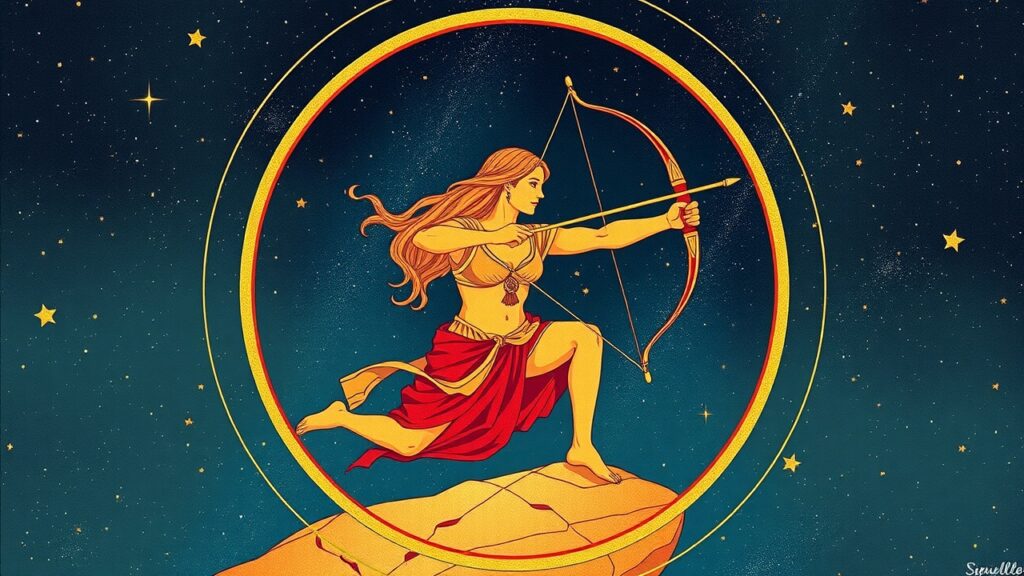
So, you’re curious about Sagittarius on April 13, 2026? Good news – it’s going to be visible! While it won’t be at its absolute peak for the year, you’ll still have a solid window to spot this fascinating constellation. Think of it as a good opportunity to get acquainted with the Archer before its prime summer viewing.
Introduction to Sagittarius: The Archer of the Zodiac
Sagittarius, often depicted as a centaur archer, is one of the most recognizable constellations in the night sky. It’s part of the zodiac, meaning the Sun passes through it over the course of a year. For us stargazers, this translates into specific times when it’s more prominent. Interestingly, while it’s a zodiac sign for those born roughly between November 22nd and December 21st, the actual constellation is best seen in the Northern Hemisphere’s summer and the Southern Hemisphere’s winter. This little quirk is due to the precession of the equinoxes – a slow wobble of the Earth’s axis over thousands of years that shifts the apparent position of the stars relative to the zodiac signs. So, if you’re a Sagittarius by birth date, you’re actually likely peering up at a different part of the sky when your “sun sign” is theoretically overhead.
What Makes Sagittarius Special?
Beyond its mythological connections, Sagittarius is home to some incredible deep-sky objects. Nestled right in the direction of the Milky Way’s galactic center, it’s a treasure trove for astronomers. We’re talking nebulae, star clusters, and even the supermassive black hole at the heart of our galaxy, Sagittarius A*. While you won’t see the black hole directly, the sheer density of stars and gas clouds in this region makes it a truly spectacular sight, especially through a telescope. It’s like looking into the bustling downtown of our galaxy. The sheer number of celestial bodies here tells a story of cosmic grandeur and immense scale.
Key Stars to Look For
When you’re trying to locate Sagittarius, look for its main asterism, often called “The Teapot.” This distinct shape is formed by eight prominent stars: Kaus Australis, Kaus Media, Kaus Borealis, Alnasl, Ascella, Nunki, and then Teapot’s “handle” which includes the stars phi Sagittarii and sigma Sagittarii. Kaus Australis (Epsilon Sagittarii) is generally the brightest star in the constellation, a blue-white giant that’s about 145 light-years away from us. Nunki (Sigma Sagittarii) is another significant one, historically important for navigation, and it’s also a hot blue star. Once you can trace out “The Teapot,” the rest of Sagittarius becomes much easier to identify. It’s a great starting point for anyone new to the constellation.
Stargazing Events in Sagittarius on April 13, 2026
Alright, let’s get down to the specifics for April 13, 2026. On this date, Sagittarius will be observable, though it will be more of a late-night to pre-dawn target, depending on your location. It won’t be high in the sky directly after sunset, so you’ll need to be patient.
Visibility from the Northern Hemisphere
For those in the Northern Hemisphere, Sagittarius will start to become visible low on the southeastern horizon later in the night. As the Earth rotates, it will climb higher, reaching its best position for viewing just before dawn. Think 3 AM or 4 AM local time for optimal viewing as it begins to clear the horizon and any potential light pollution or atmospheric haze. It’s a good opportunity to see it before it gets lost in the dawn light. The lower it is, the more atmosphere you’re looking through, which can diminish clarity. A clear, moonless night would be ideal for picking out some of those fainter objects within the constellation.
Visibility from the Southern Hemisphere
The Southern Hemisphere has a much better deal when it comes to Sagittarius. On April 13, 2026, it will be significantly higher in the sky and visible for a longer duration of the night. It will rise earlier and stay visible longer, making for a more comfortable and extended viewing experience. This is one of the constellations where being south of the equator really pays off. You might even find it overhead at some point in the night, offering a truly spectacular view with minimal atmospheric interference. This is why many professional observatories are located in the Southern Hemisphere.
Deep-Sky Objects to Target
Even though April 13 isn’t peak viewing, with a good telescope and dark skies, you can still spot some amazing objects in Sagittarius. The Lagoon Nebula (Messier 8 or M8) and the Trifid Nebula (Messier 20 or M20) are perennial favorites. Both are emission nebulae, meaning they are glowing clouds of gas and dust where new stars are forming. M8 is particularly bright and large, easily visible with binoculars even from moderately light-polluted areas. M20, while smaller, is known for its distinctive three-lobed appearance. Also keep an eye out for Messier 22 (M22), a magnificent globular cluster, one of the brightest and closest to Earth. These are all within the “Teapot” area, so once you find that, you’re in the right neighborhood.
Best Locations for Observing Sagittarius in the Night Sky
Where you choose to observe makes a huge difference. Light pollution is the enemy of stargazing, so getting away from city lights is paramount. If you’re interested in reading your horoscope, you can check it out here.
Dark Sky Preserves and National Parks
Your best bet for truly dark skies is a designated Dark Sky Preserve or a remote National Park.
These locations often have regulations in place to minimize light pollution, offering pristine conditions for observing. In the US, places like Big Bend National Park in Texas or Death Valley National Park in California are renowned for their dark skies. Internationally, destinations like the Atacama Desert in Chile or parts of New Zealand offer unparalleled views.
These spots aren’t just great for Sagittarius; they’re fantastic for seeing the entire Milky Way arc across the sky.
Rural Areas Away from City Lights
If a Dark Sky Preserve isn’t feasible, simply driving a good distance away from any major city can significantly improve your viewing experience. Even a few miles outside a town can make a noticeable difference. Look for areas with minimal streetlights and no immediate neighbors with bright outdoor lighting.
An open field or a hilltop can provide an unobstructed view of the horizon, helpful when Sagittarius is still relatively low. Remember to check local regulations about where you can set up and observe. Parking in designated areas or obtaining permission from landowners is important.
Backyard Stargazing (with caveats)
For those stuck in more urban or suburban environments, backyard stargazing is still possible, but your expectations need to be adjusted.
You likely won’t see the fainter nebulae, but you can still identify the brighter stars of the Teapot and potentially some of the brighter star clusters with binoculars or a small telescope. The key is to find the darkest spot in your yard, away from house lights, and let your eyes adapt to the darkness for at least 20-30 minutes. Even if you can’t see everything, the act of connecting with the night sky from your own home can be incredibly rewarding.
Astronomy Workshops and Events for Sagittarius Enthusiasts
| Date | Event | Location | Attendance |
|---|---|---|---|
| June 15, 2021 | Sagittarius Constellation Workshop | Local Planetarium | 50 |
| July 20, 2021 | Stargazing Night | Outdoor Observatory | 75 |
| August 10, 2021 | Galactic Center Observation | Mountain Peak | 30 |
While specific events for April 13, 2026, might not be explicitly announced this far in advance, it’s worth keeping an eye out. Many astronomy clubs and observatories hold regular events that could coincide with good Sagittarius viewing.
Local Astronomy Club Meetups
Search online for astronomy clubs in your area. Many clubs host public stargazing nights, often at dark-sky locations. They’ll typically have telescopes set up and experienced members who can guide you through the night sky, pointing out constellations, planets, and deep-sky objects. This is an excellent way to learn, ask questions, and use high-quality equipment you might not own yourself. Even if they don’t explicitly market it as a “Sagittarius event,” if the constellation is visible, they’ll likely point it out.
Public Observatory Programs
Many observatories, both professional and amateur, offer public viewing programs. These can range from guided tours of their facilities to dedicated stargazing sessions. These events are often led by astronomers who can provide fascinating insights into the celestial objects you’re viewing. Check the websites of observatories near you for their event calendars. Some might even have special equipment for astrophotography or deep-sky viewing that’s accessible to the public.
Online Resources and Virtual Events
If in-person events aren’t an option, there’s a wealth of online resources. Many astronomy groups and professional observatories host virtual stargazing events, webinars, and live streams, especially during significant celestial events. While you won’t be looking through a telescope directly, these can still be incredibly informative and inspiring, allowing you to experience the wonders of the night sky from the comfort of your home. They often include expert commentary and stunning images.
Tips for Photographing Sagittarius Constellations

Photographing the night sky, especially constellations like Sagittarius, can be incredibly rewarding but requires a bit of practice and the right gear.
Essential Equipment
You don’t need a super expensive setup to get started. A DSLR or mirrorless camera with manual controls, a wide-angle lens (f/2.8 or wider is ideal), a sturdy tripod, and a remote shutter release are your basic tools. For tracking the sky and getting longer exposures without star trails, a star tracker (equatorial mount) is highly recommended. While you can certainly start without one, it opens up a whole new world of astrophotography possibilities.
Camera Settings for Wide-Field Shots
For wide-field shots of Sagittarius, you’ll generally want to use a wide aperture (e.g., f/2.8 or f/4), a high ISO (e.g., 1600-6400, depending on your camera’s noise performance), and an exposure time of 15-30 seconds. The exact exposure time will depend on your focal length and whether you’re using a star tracker to avoid star trails. A good rule of thumb without a tracker is the “500 Rule”: divide 500 by your focal length to get the maximum exposure time in seconds before stars start to trail. Focus manually on a bright star (use live view and zoom in) or use the infinity focus marking on your lens.
Advanced Techniques for Deep-Sky Objects
To capture the fainter nebulae and star clusters within Sagittarius, you’ll definitely want a star tracker. This allows for much longer exposures (several minutes or even hours) without star trails. You’ll also likely want to stack multiple images together in post-processing software (like DeepSkyStacker or PixInsight) to reduce noise and bring out more detail and color. This process involves taking many short exposures and then combining them, which dramatically improves the signal-to-noise ratio. Using a telescope to gather more light and provide higher magnification for these smaller, fainter targets is also a common practice among advanced astrophotographers.
Mythology and History of Sagittarius in Astronomy
The story behind Sagittarius is as rich and fascinating as the stars themselves, deeply intertwined with human culture and early astronomical observations.
The Myth of the Archer
Sagittarius is usually identified with a centaur, a mythological creature with the upper body of a human and the lower body and legs of a horse. Often, this is said to represent Chiron, the wisest and most just of all centaurs. Unlike his wild brethren, Chiron was known for his wisdom, knowledge of medicine, and skill in archery. He was a teacher to many Greek heroes, including Hercules, Achilles, and Jason. The constellation depicts him with his bow drawn, aiming an arrow towards Antares, the heart of the scorpion (Scorpius), perhaps as a warning to keep the deadly creature at bay. This imagery of a skilled, wise archer has resonated through centuries.
Historical Significance in Navigation and Calendars
Before modern navigation, constellations like Sagittarius were vital tools for sailors and travelers. Their predictable movements across the night sky allowed for accurate direction finding and timekeeping. Ancient civilizations also used the appearance and disappearance of constellations to mark seasonal changes, crucial for agriculture and developing early calendars. The position of Sagittarius relative to the Sun, for instance, would have indicated specific times of the year, although as mentioned earlier, the relationship between zodiac signs and constellations has shifted over millennia.
Cultural Depictions Across Civilizations
While the Greek myth of the centaur archer is most commonly associated with Sagittarius, various cultures have had their own interpretations. Some ancient Mesopotamian cultures, for example, saw a slightly different composite creature, sometimes a scorpion-man or a beast with a lion’s head. The concept of an archer figure, representing skill, hunting, and sometimes divine justice, is a recurring theme in many sky maps across different civilizations, demonstrating a shared human experience of projecting stories onto the stars.
Future Opportunities for Observing Sagittarius in the Night Sky
While April 13, 2026, is a good starting point, Sagittarius will be even better in the months following.
Peak Viewing Seasons
The prime time for observing Sagittarius from the Northern Hemisphere is during the summer months, particularly July and August. During this period, the constellation rises earlier in the evening and climbs much higher in the sky, offering extended viewing opportunities throughout the night. From the Southern Hemisphere, it’s best seen during their winter months (June, July, August), when it can reach a very high altitude, sometimes directly overhead, providing truly magnificent views of the Milky Way’s core. Mark your calendars for these times if you want to experience Sagittarius at its absolute best.
Upcoming Astronomical Events
While no specific “Sagittarius-centric” astronomical event is locked in for the immediate future (like a meteor shower directly originating from it), the general observing conditions for the constellation remain consistent year after year. Always keep an eye on astronomical calendars for meteor showers (like the Perseids or Geminids, which are often best viewed under dark, moonless skies), lunar phases (new moon is always best for deep-sky objects), and planet conjunctions which can add extra interest to a night of stargazing.
Long-Term Stargazing Planning
For any dedicated amateur astronomer, a long-term plan is helpful. Keep a log of your observations, noting dates, times, equipment used, and what you saw. This helps you track progress and identify the best viewing windows for different objects. As you gain experience, you might invest in better equipment, explore different observing techniques, or even join star parties in different locations. The night sky is always changing, and there’s always something new to discover, making each viewing of Sagittarius a unique experience.
FAQs
What is Sagittarius and why is it significant in astronomy?
Sagittarius is a constellation located in the southern hemisphere and is known for its prominent asterism, the Teapot. It is significant in astronomy as it is home to the center of our galaxy, the Milky Way, and contains many interesting celestial objects such as nebulae, star clusters, and the galactic bulge.
What are some stargazing events happening in Sagittarius on April 13, 2026?
On April 13, 2026, stargazers can look forward to the peak of the Lyrid meteor shower, which will be visible in the vicinity of Sagittarius. Additionally, the planet Jupiter will be in close proximity to the constellation, offering a great opportunity for observation.
Where are the best locations for observing Sagittarius in the night sky?
The best locations for observing Sagittarius in the night sky are those with minimal light pollution and a clear view of the southern horizon. Ideal spots include high elevation areas, remote countryside locations, and designated dark sky reserves.
What are some tips for photographing Sagittarius constellations?
To photograph Sagittarius constellations, it is recommended to use a DSLR camera with a wide-angle lens and a sturdy tripod. Long exposure times and low ISO settings can help capture the faint details of the Milky Way and other celestial objects within the constellation.
What are some future opportunities for observing Sagittarius in the night sky?
Future opportunities for observing Sagittarius in the night sky include the annual return of the Milky Way to the evening sky during the summer months in the northern hemisphere. Additionally, specific astronomical events such as planetary alignments and meteor showers will provide opportunities to view Sagittarius in the future.